
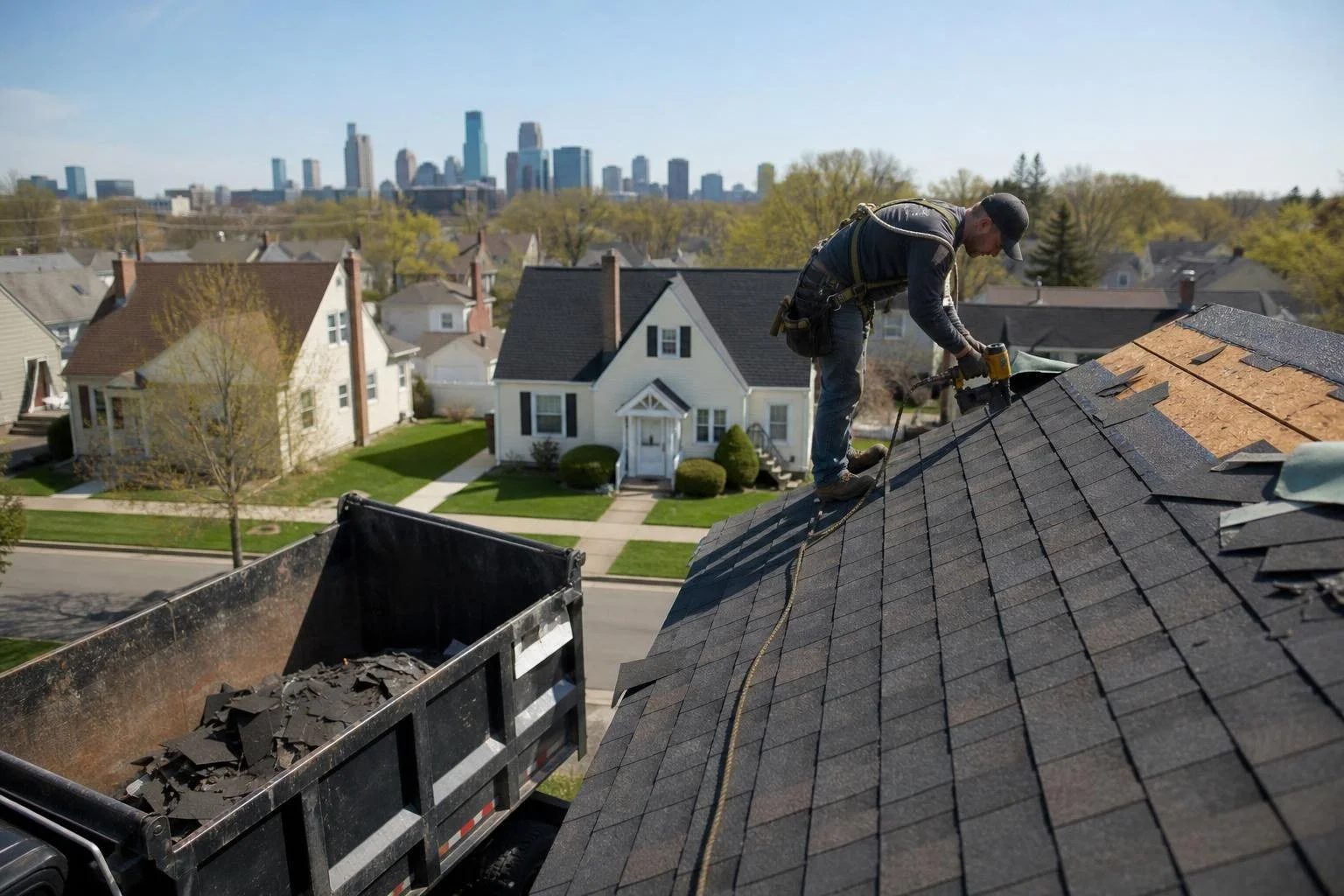
Spend a couple of Minnesota winters under a tired roof and you start noticing things: ice dams along the eaves, granules collecting at the bottom of the downspouts, a brown stain spreading on the bedroom ceiling every March. Eventually the question changes from "Can I patch this again?" to "What will a full replacement actually cost me?"
The honest answer is that asphalt shingle roof replacement cost in the Twin Cities varies more than most homeowners expect. Two houses on the same block in Roseville can get quotes thousands of dollars apart, and both quotes can be fair. The gap comes from roof geometry, material choices, what's hiding under the old shingles, and how busy local crews are after the latest hailstorm.
This guide breaks down where your money goes, which line items deserve scrutiny, and how to hire a contractor without overpaying or cutting the wrong corners. The figures below are typical ranges, not quotes, so use them to calibrate expectations before you start collecting bids.
Average Costs for Asphalt Roof Replacement in Minneapolis and St. Paul
Roofers price jobs by the "square," which equals 100 square feet of roof surface. Your roof is almost always larger than your home's footprint because of the pitch and the overhangs. A 1,600-square-foot rambler might have 20 to 24 squares of actual roofing.
Typical metro pricing for a full tear-off and replacement looks roughly like this:
Small rambler or bungalow
15-20 squares
$9,000 - $15,000
Mid-size two-story
22-30 squares
$13,000 - $22,000
Large or complex home
35+ squares
$22,000 - $40,000+
These numbers assume architectural shingles, removal of one existing layer, standard underlayment, and ice-and-water shield along the eaves. On a per-square basis, most Twin Cities homeowners can expect to land somewhere between $550 and $900 per square installed, with steep or cut-up roofs pushing higher.
Treat these as starting points. Pricing moves with material costs and storm demand, and a quote far below the range usually means something is missing from the scope.
Key Factors Influencing Your Twin Cities Roofing Estimate
Contractors aren't pulling numbers from thin air. Every estimate is built from a handful of measurable variables, and once you understand them, you can read a quote critically instead of just comparing totals.
Roof Size and Pitch Complexity
Size is the obvious driver, but pitch and shape often matter just as much. A simple gable roof on a Richfield rambler is about as easy as roofing gets: two flat planes, a ridge, and not much else. Crews can walk it, stage materials easily, and finish in a day.
Compare that to a 1920s Tudor in Linden Hills with a 12/12 pitch, multiple dormers, valleys, and a chimney. Steep roofs require harnesses, roof jacks, and slower work. Every valley, hip, and penetration adds cutting, flashing, and waste. It's common for steep, complex roofs to cost 25 to 50 percent more per square than a walkable roof of the same size.
Access counts too. If the crew can't back a dumpster or a boom truck up to the house, expect labor time (and cost) to climb.
Material Tiers: 3-Tab vs. Architectural Shingles
Three-tab shingles are the flat, uniform style found on older homes. They're the cheapest option, but they're thinner, carry lower wind ratings, and many manufacturers have scaled back their three-tab lines. In practice, most local roofers now steer customers away from them.
Architectural (dimensional) shingles are the current standard. They're laminated for a thicker, textured look, they handle wind better, and the price difference is usually modest, often around 10 to 20 percent more for materials.
At the top end, you'll find:
Impact-resistant (Class 4) shingles: Engineered to survive hail better, a serious consideration in this region.
Designer shingles: Heavier products that mimic slate or cedar shake, priced well above standard architectural lines.
For most Twin Cities homes, a good architectural shingle offers the best balance. Class 4 is worth pricing if you've already been through hail claims.
The Impact of Minnesota Weather on Material Longevity and Price
Minnesota is hard on roofs. Freeze-thaw cycles, heavy snow loads, summer heat, and hail all take their toll. A shingle rated for 30 years in a mild climate may realistically give you 18 to 25 years here, depending on ventilation and exposure.
Ice dams are the local villain. Heat escaping from the attic melts snow on the upper roof, the water runs down to the cold eaves, refreezes, and backs up under the shingles. That's why ice-and-water shield along the eaves is non-negotiable in this climate, and why good contractors run it at least a couple of feet past the interior wall line, plus in valleys and around chimneys.
Hail shapes the market in a less obvious way. After a major storm, demand spikes across the metro, out-of-state crews flood in, and schedules fill for months. Prices can firm up, and quality gets uneven. If your roof is aging but not urgent, getting estimates in late winter or early spring, before storm season, can give you better scheduling and more negotiating room.
Weather also affects installation. Shingles need warmth to seal properly, so late-fall jobs sometimes require hand-sealing, which adds labor.
Labor and Local Permitting Expenses in the Metro Area
Labor typically makes up a large share of a roofing bill, often around half or more. That covers tear-off, disposal, installation, cleanup, and the contractor's overhead, including insurance and warranty backing. Skilled roofing labor isn't cheap in the metro, and it shouldn't be: the person nailing your shingles determines whether the manufacturer warranty holds up.
Minnesota requires residential roofers to be licensed through the state Department of Labor and Industry. Always check a contractor's license number before signing. An unlicensed roofer might quote lower, but you lose consumer protections, including access to the state's contractor recovery fund.
Permits are required for reroofing in Minneapolis, St. Paul, and most suburbs. Fees vary by city and are usually based on project valuation, typically running from a little over a hundred dollars to several hundred. Your contractor should pull the permit, and it should appear on the quote. If someone suggests skipping it to save money, take that as a reason to walk away. Inspections catch underlayment and flashing mistakes, and unpermitted work can create headaches when you sell.
Disposal is another line item. Tear-off debris is heavy, and dumpster and landfill fees are typically folded into the per-square price.
Hidden Costs: Decking Repairs and Ventilation Upgrades
The biggest surprise on most roofing jobs shows up only after the old shingles come off. Rotted, delaminated, or soft roof decking has to be replaced before new shingles go on. On an older home with past leaks, that can mean a few sheets or a few dozen.
Good contractors handle this transparently. Look for a per-sheet price for replacement plywood or OSB written into the contract, often somewhere in the range of $75 to $125 per sheet installed. Some quotes include a set number of sheets; others bill afterward. Either is fine as long as it's spelled out.
Older Twin Cities homes bring a related wrinkle: plank (board) decking with gaps between boards. Some shingle manufacturers won't warranty installation over gapped planks, so a contractor may recommend overlaying the whole roof with plywood. That can add a few thousand dollars to the job.
Ventilation is the other common add-on, and it matters a lot here. A poorly vented attic cooks shingles from below in summer and feeds ice dams in winter. Upgrades might include:
Ridge vents: Replacing box vents with continuous ridge ventilation.
Soffit intake: Adding or clearing soffit vents so air can actually move.
Bath fan reroutes: Venting exhaust outside rather than into the attic.
These rarely cost more than a few hundred to a couple thousand dollars, and they protect everything else you're paying for.
Maximizing ROI and Selecting a Local Roofing Contractor
A new roof won't return every dollar at resale, but it ranks among the projects buyers notice most. An old roof often becomes a negotiating point during inspection, and a new one removes that objection entirely. You also get lower repair risk, fewer ice dam headaches, and possibly a better homeowner's insurance rate if you choose impact-resistant shingles.
The contractor you choose matters more than the shingle brand. A premium shingle installed badly will fail early; a mid-range shingle installed well will outlast its rating.
Comparing Quotes and Warranty Options
Get at least three written quotes, and compare scope, not just totals. Check that each one specifies:
Number of squares and shingle product line
Tear-off of all existing layers
Ice-and-water shield coverage and underlayment type
Flashing replacement (not reuse) around chimneys and walls
Ventilation plan
Per-sheet decking replacement price
Permit, disposal, and cleanup
Warranties come in two layers. The manufacturer covers material defects, while the workmanship warranty covers installation errors. Many manufacturers offer enhanced system warranties when a certified installer uses their full component line, which can extend coverage for workmanship too. Ask exactly who stands behind a leak in year eight, and get it in writing.
Financing and Insurance Claim Considerations
If hail or wind caused the damage, your homeowner's policy may cover much of the replacement minus your deductible. Call your insurer first, document the damage with dated photos, and be cautious about storm chasers who knock on doors promising a "free roof." In Minnesota, it's illegal for contractors to offer to cover or rebate your deductible, so treat that offer as a warning sign. Review your policy as well, since some coverage pays depreciated value up front and the balance only after work is complete.
For out-of-pocket projects, many roofers offer financing through third-party lenders, sometimes with promotional interest periods. Compare that against a home equity line or personal loan, and read the fine print on deferred-interest offers.
The roof that costs the least on paper is rarely the cheapest over twenty years. When you're sizing up asphalt shingle roof replacement costs across the Twin Cities, budget for the realities of this climate: proper ice protection, solid decking, and an attic that breathes. Then hire a licensed local contractor who itemizes everything and backs their work. Do that, and you'll stop watching the ceiling every March.